Combined Arthroscopic, Open Reconstructive Surgery Helps Alleviate Post-Scope Hip Pain
September 2, 2020Categories: Cover Story
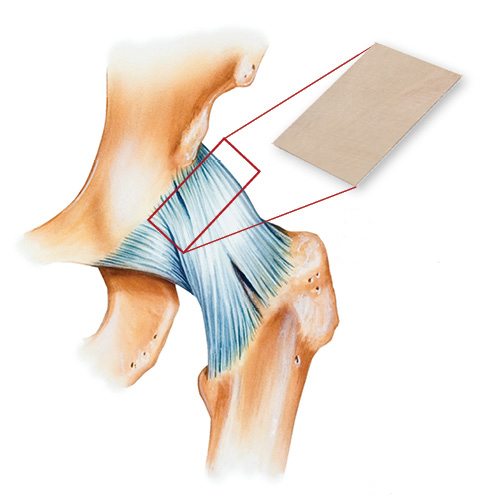 Allograft for reconstruction of capsular defect
Credit: MTS Biologics
When patients continue to have hip pain and dysfunction after arthroscopy, a capsular defect may be the culprit.
We often see this defect in people who have had arthroscopy for femoroacetabular impingement due to a pincer lesion or a cam deformity,” said Dustin S. Woyski, DO, an orthopedic surgeon with Northland Orthopedics & Sports Medicine. “In a hip scope, surgeons have to cut through the capsule, causing an iatrogenically created defect in their iliofemoral ligament. Capsules can heal on their own, but some do not. It’s becoming standard of care to close the capsule at the end of the procedure.”
Dr. Woyski offers relief through combined arthroscopic and open hip capsular reconstruction.
Hip Pain
Patients with a capsular defect can have microinstability, which leaves them achy and sore at the front or side of their hip or at their buttocks. Their pain also is worse when they walk. They may be unable to alleviate their pain with rest, modified activities, exercise and anti-inflammatory medications.
“On MRI with contrast, we’ll see contrast leak out of the joint, a telltale sign of a capsular defect that has not healed,” Dr. Woyski said.
Combined Surgery
Defect sizes vary, from small to very large. “It’s a big surgery to reconstruct the capsule and takes four to six hours,” said Dr. Woyski, whose hip preservation and reconstruction fellowship training at Duke University Hospital introduced him to combined arthroscopic and open hip capsular reconstruction.
Dr. Woyski said. “Arthroscopically, I can better visualize their placement. “After I pass my sutures to the intact ligament on the femoral side, I’m ready to move to open surgery. There, I can visualize the femoral head and socket, shuttle the graft down while passing my sutures through it, and then tie down and attach the graft.”
Patients typically have an overnight hospital stay and go home on crutches for six to eight weeks. If the patient is a runner, they can start back in four to five months. People with arthritis are not surgical candidates.
Dustin S. Woyski, DO
Dr. Woyski earned his medical degree from Kansas City University of Medicine and Biosciences and completed his orthopedic internship and residency at Oklahoma State University/ St. Anthony Hospital. He was a fellow in hip preservation and reconstruction at Duke University Hospital.