New PET/CT scanner enhances cardiac imaging and efficiency
July 15, 2026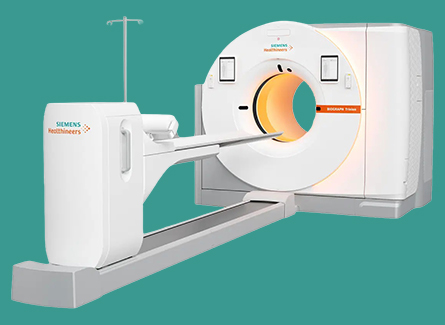

Stephen Gimple, MD
NKC Health Heart Care recently enhanced its advanced cardiac imaging program with the installation of a Siemens Biograph Trinion PET/CT scanner, made possible through a grant from Dave and Jamie Cummings.
The new system delivers improved image quality, AI-assisted image processing and greater efficiency, helping providers make more confident clinical decisions while improving patient throughput.
“It doesn't change who we're scanning or what we're looking for,” said Stephen Gimple, MD, cardiologist with NKC Health Heart Care. “It allows us to do it faster and with greater confidence because the images are clearer. When something is abnormal, it's more obvious. When it's normal, that's more obvious, too.”
Enhancing image quality and workflow
The scanner's more sensitive detectors produce higher-quality images with improved spatial resolution, making subtle abnormalities easier to identify while reducing imaging artifacts.
The system also uses artificial intelligence to automate image registration, quality control and portions of patient positioning. Rather than interpreting studies, AI streamlines image processing and helps reduce manual steps for technologists, improving workflow consistency while allowing staff to focus more on patient care.
For referring providers, the streamlined workflow increases scheduling flexibility and creates additional capacity for urgent imaging.
“Because each scan takes less time, we're better able to accommodate add-on patients when needed,” Dr. Gimple said. “That can make a meaningful difference for patients who need timely cardiac evaluation.”
Supporting clinical decision-making
Beyond operational improvements, this technology strengthens the clinical value of cardiac PET/CT imaging. Unlike some traditional nuclear stress tests, PET/CT measures absolute myocardial blood flow, allowing physicians to identify balanced multivessel coronary artery diseases that might otherwise appear normal.
Traditional nuclear stress tests compare blood flow between different regions of the heart. When blood flow is reduced equally throughout the heart, those differences can be difficult to detect. By measuring absolute blood flow, PET/CT can identify these high-risk patients with greater confidence.
“PET/CT helps us determine which patients truly need an invasive heart catheterization and which patients can continue with medical therapy,” Dr. Gimple said.
The scanner also offers patients shorter exam times and lower radiation exposure compared with some traditional nuclear imaging studies.
“This technology keeps us at the forefront of noninvasive cardiac perfusion imaging,” Dr. Gimple said. “Dave and Jamie Cummings’ generosity strengthens our ability to deliver advanced cardiac imaging and exceptional care to our community.”