What every woman should know about mammograms
October 22, 2026By: Trevin Lambert
Categories: Cancer, Women's Care
Key takeaways:
- Mammograms can find breast cancer before you can feel it.
- Regular screening can detect small changes and cancers at an earlier stage, which is the central reason screening matters.
- Know when you're due, talk with your provider about your personal risk and consider finding a “mammogram buddy” who will schedule with you and help you stay on track.
Most of us are pretty good at making a doctor's appointment when something hurts. Mammograms ask us to do the opposite: Make the appointment when everything seems perfectly fine.
On a recent episode of the NKC Health podcast Care Empowered, Carl Van Tasell, MD, a radiologist with Northland Radiology, and Mindy Coates, RT, RDMS, RVT, a radiology operations supervisor with NKC Health, discussed why a mammogram is one of the most important tools for finding breast cancer early.
What is a mammogram?
A mammogram is an X-ray of the breast that can detect changes in breast tissue, including some cancers before they can be felt or cause symptoms.
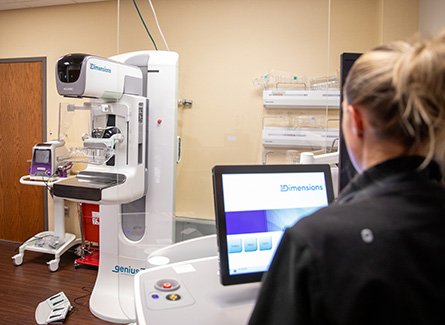
These specialized X-rays create images of the breast. During the exam, each breast is briefly compressed between two plates so the imaging team can get clear pictures of the breast tissue.
A screening mammogram typically involves four images, two of each breast. The technologist reviews the images before you leave to make sure the breast tissue is adequately captured. The entire appointment is typically less than 30 minutes.
There are two types of mammograms:
- Screening mammograms look for early signs of breast cancer when there are no symptoms.
- Diagnostic mammograms are recommended if you have symptoms or if a screening mammogram shows an area that needs a closer look.
Why are mammograms important?
Breast cancer is one of the most common cancers among women in the United States. The biggest benefit of a mammogram is the ability to find breast cancer before you can see or feel a change.
“Regular screening gives a patient the best chance of finding cancer in a new stage, and it can be lifesaving,” Dr. Van Tasell said.
Early detection means finding cancer while it is still small and before it has spread to the lymph nodes or other organs. Some breast cancers don't cause symptoms in the early stages. A mammogram can identify changes that may not be detectable during a physical exam, giving you and your healthcare team an opportunity to find and treat cancer earlier.
When should I start getting mammograms?
The right time to start screening depends on your risk factors and your healthcare provider's recommendations.
During the interview, Dr. Van Tasell noted that the age at which women begin routine mammography has shifted over time due to risk factors and advancing technology, with many women starting earlier and around age 35 instead of 40. He also commented that improvements in mammography technology have made it possible to detect smaller cancers earlier.
Your recommended screening schedule may be different depending on your age, family history, breast density, previous mammogram results and other risk factors. Women at higher risk may need additional imaging or a different screening schedule.
Talk with your provider about when you should begin screening and the frequency.
What can I expect during my first mammogram?
It's understandable to feel nervous for your first mammogram, but the process is relatively quick.
After you check in, a technologist will escort you to a private dressing room and explain the exam. You'll change into a gown from the waist up before entering the mammography room.
The appointment itself is typically less than 30 minutes. And if you're worried about discomfort, talk with your technologist.
“It's so important for a patient to feel like they've been seen and heard,” Coates said.
The technologists at NKC Health take time to talk with patients and answer questions during the exam. Many patients return to the same technologists year after year, building a relationship that can make future screenings even more comfortable.
A few things to know before your mammogram
Skip deodorant. Deodorant can sometimes appear as calcifications on a mammogram, which can make images harder to interpret. Dr. Van Tasell recommends avoiding deodorant before your appointment.
Consider a morning appointment. If your mammogram is completed in the morning or early afternoon, your results may be available in the patient portal the same day, depending on when the radiologist reviews the images.
Talk to your technologist. If you're nervous or uncomfortable, let your technologist know. Communication can help make the experience more comfortable.
Make your next appointment part of your routine. Some women schedule their mammogram around the same time every year.
What is a 3D mammogram?
You may have heard the terms 2D and 3D mammography. Three-dimensional mammography, also called tomosynthesis, is used at NKC Health and creates more detailed images of the breast that allows the radiologist to look through the breast tissue.
Dr. Van Tasell compared it to looking inside the breast rather than viewing it from just one angle. He explained that 3D mammography can help radiologists determine whether an area that appears unusual on a traditional image is actually a mass or just dense tissue.
This more detailed view can give radiologists greater confidence when evaluating a screening mammogram.
What if I have dense breasts?
Breast density refers to the amount of fibroglandular tissue compared with fatty tissue in the breast. Dense breast tissue can make it more difficult for a mammogram to detect some cancers.
“A mammogram picks up small calcifications in the breast, which can be the first sign of breast cancer,” Dr. Van Tasell said. “An ultrasound, meanwhile, can be helpful for finding soft-tissue masses or cysts.”
Your mammogram report will include information about your breast density. If you have questions about what your breast density means or whether you need additional screening, talk with your provider.
Find a mammogram buddy
If you have a friend who has delayed her mammogram, make an appointment together.
“We have some women who come in with buddies,” Coates said. “They call each other mammogram buddies, and they hold each other accountable.”
It can be a simple way to make an annual screening part of your routine and a little less intimidating. Pick a date, schedule your appointments and make a plan to keep each other on track each year.
Make your mammogram part of your routine
Breast Cancer Awareness Month is a good reminder to take care of your breast health, but screening shouldn't be limited to October.
If you're overdue for a mammogram, make the appointment.
“Your health is important. Make yourself a priority and come in and do it,” Dr. Van Tasell said.
If you're unsure when to begin screening or the frequency, talk with your provider. Knowing your personal risk and staying up to date with recommended screenings can help you take an active role in your breast health.
Schedule your mammogram today at nkchealth.org/Mammo.