Types of Weight Loss Procedures

Key Takeaways
- All Total Weight Loss bariatric surgeries are minimally invasive, reducing recovery time and complications.
- Different procedures — gastric bypass, sleeve gastrectomy and duodenal switch — vary in permanence and how much the surgeon alters the stomach or intestines.
- Revision surgery is available for patients with previous weight loss procedures who experienced complications or insufficient results.
Bariatric surgery at Total Weight Loss includes several minimally invasive procedures that shrink the stomach to help with weight loss. Options include gastric bypass, sleeve gastrectomy, duodenal switch and revision surgeries. We offer a free information session so you can learn more.
Surgery for weight loss is called bariatric surgery. There are many different types of bariatric surgeries. All of them shrink your stomach so that you feel full faster and cannot eat as much food or absorb as many nutrients. This leads to weight loss and better health.
All weight loss surgeries at the Total Weight Loss are done as minimally invasive procedures by our board-certified surgeons. This means several small incisions are made in your abdomen rather than one large cut. The result is less blood loss and faster recovery than a traditional open surgery.
Each procedure takes between one and three hours, depending on the procedure, and requires an average of one overnight stay at the hospital. After surgery, you will need to carefully follow instructions and make lifestyle changes for the best result.
Types of bariatric procedures
You will discuss your options with your Total Weight Loss care team. Together, you can decide which type of surgery is the best fit. The choice depends on your goals, health conditions, surgical history, insurance and other factors.
Gastric bypass
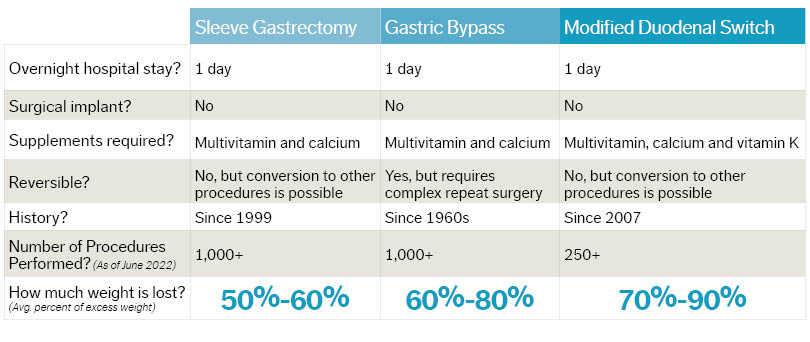
During gastric bypass, the surgeon divides the top of the stomach to create a small separate pouch. One end of the small intestine is attached to the new pouch. Food bypasses the rest of the stomach and the first part of the small intestine. This procedure is technically reversible because the stomach is divided and not partially removed as it is in sleeve gastrectomy. However, reversal surgery is very complex.
Sleeve gastrectomy
Also called gastric sleeve surgery, sleeve gastrectomy involves the surgeon removing 80% of the stomach. This creates a smaller stomach that holds much less food than before. This smaller stomach is shaped like a banana and called a gastric sleeve. The procedure is permanent and may be the safest weight loss surgery, with a lower risk of complications than gastric bypass.
Duodenal switch
The modified duodenal switch surgery combines aspects of the sleeve gastrectomy and the gastric bypass. In this procedure, the surgeon removes 80% of the stomach, creating a narrow pouch. Then, the last part of the small intestine is connected directly to the new pouch so that food bypasses a large portion of the small intestine. This procedure is not reversible.
Revisions
- Bariatric revision surgery is for people who have had a weight loss surgery before. Reasons for revision surgery may include:
Complications, such as slippage, related to a previous lap band procedure - Severe, persistent acid reflux resulting from a previous procedure
- Inadequate weight loss or regaining weight after previous procedure
Compare surgical weight loss procedures
Free information session
Hear from our surgeons and other members of our multidisciplinary team to see if bariatric surgery is right for you.
View free information session
People Also Ask
How long does bariatric surgery take?
Bariatric surgery done laparoscopically typically takes one to three hours, depending on the type of procedure.
What is the safest surgery for weight loss?
Sleeve gastrectomy is generally considered the safest weight loss surgery. It has a lower risk of complications compared to gastric bypass and duodenal switch.
How much weight will I lose with bariatric surgery?
Weight loss varies by procedure. You may lose 50%-80% of body weight within 12-18 months after surgery.
What are the long-term risks of bariatric surgery?
Possible risks include nutrient deficiencies, acid reflux or surgical complications.
Will I need a special diet after bariatric surgery?
Yes. You must follow a special diet plan and take supplements.